
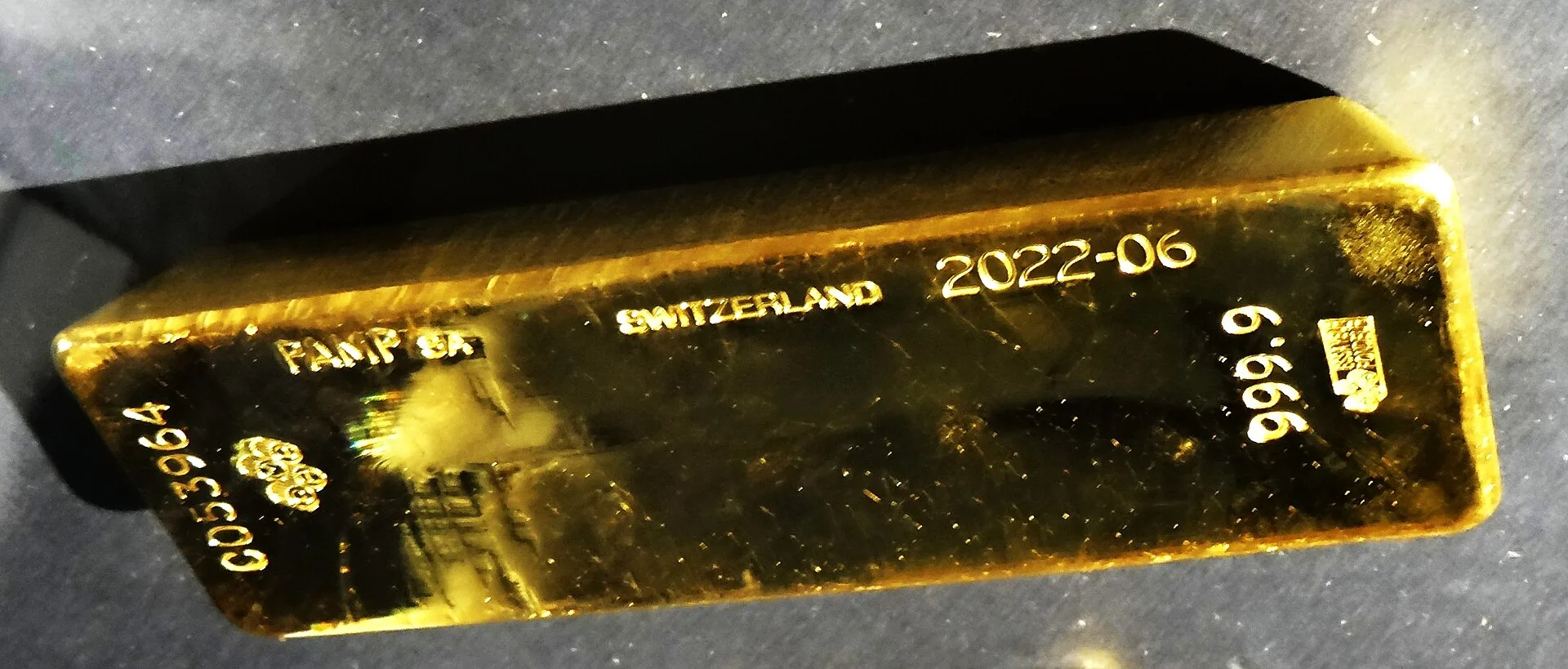
The textbook is unambiguous: gold pays no yield, so when real rates rise, gold falls. Eight days before a Federal Reserve meeting the market treats as a coin flip on a rate rise, gold trades at $4,405.50 an ounce and is up 22.4% over twelve months. Those two sentences are both true, and the tension between them is the most interesting thing in the commodity complex this week.
The precise shape of it matters, because the bulls and the bears both overstate their case. Gold is not rallying on the Middle East war – it is up only 2.9% year to date, and it sits 16.3% below the record close of $5,318.40 set on 29 January. What gold is doing is refusing to fall in the face of a hiking cycle that, by every conventional model, should have taken it down hard. Polymarket prices a 25 basis point hike on 16 September at 51.5%, no change at 47.5%, and a cut at 0.5%. The cut is not merely unlikely. It is gone. And the metal has barely flinched.
Key facts: gold on 8 September 2026
- Spot gold: $4,405.50 an ounce at 13:07 GMT on 8 September 2026 (gold-api.com); front-month futures $4,451.90, the gap being carry rather than disagreement
- Twelve-month performance: +22.4%, from $3,638.10 on 8 September 2025 (Yahoo Finance, GC=F daily closes)
- Year to date: +2.9% from the $4,325.60 close of 31 December 2025 – the bulk of the twelve-month gain was earned before the end of January
- Distance from the record: 16.3% below the $5,318.40 close of 29 January 2026; the 52-week range is $3,618.40 to $5,586.20
- What the Fed is expected to do: hike 51.5%, hold 47.5%, cut 0.5% on Polymarket; CME FedWatch put the odds of a move at 66.1% after Chair Kevin Warsh’s Jackson Hole speech; Kalshi has shown 48-55%
- The rate backdrop: the US 10-year Treasury yield is 4.784%, within two basis points of its 52-week high; the VIX is 15.73
- The geopolitical backdrop: Brent $98.63 and WTI $93.89, up 12.4% and 14.3% over thirty days after Houthi strikes on Saudi energy sites
- The calendar: PPI on 10 September, August CPI on 11 September, FOMC decision on 16 September, Bank of Japan on 17-18 September
Why gold is holding when the rate path says it should not
Four forces are doing the work, and only one of them is the war.
Central banks are still buying, and they do not care about the Fed. This is the structural bid underneath the whole market, and it is price-insensitive by design: reserve managers buy to diversify away from dollar assets, not to trade the Fed’s next move. The divergence between what those buyers say they are doing and what forecasters expect is something we examined in detail in our note on central bank gold demand. A buyer who is indifferent to the policy rate removes the mechanism through which a hike is supposed to hurt.
The exchange-traded complex has not cracked. SPDR Gold Shares closed at $406.77, up 22.9% over twelve months, and its implied holdings work out at 0.0923 ounces per share against the 0.1 the trust launched with in 2004 – a decay consistent with the expense ratio alone. That is the clean tell that no forced unwind is under way. If Western institutional money were capitulating on the rate outlook, it would show up here first, and it has not.
The war supplies a floor rather than a rally. Iran-aligned Houthi forces struck Saudi Aramco facilities on 8 September with drones and ballistic missiles, wounding more than 70 people and halting operations at some sites. Brent ran to $99.16, its highest since 24 July. Gold’s response was muted, but the direction of the risk is one-sided: the Strait of Hormuz, which handled roughly a fifth of global seaborne oil and LNG before the conflict began in late February, is still running below normal throughput, and full recovery is not expected until late in the first quarter of 2027. Vitol chief executive Russell Hardy said this week that crude is transiting again at roughly 10 million barrels a day but that the squeeze has moved downstream into refined fuels.
And the debasement trade has not gone away. This is the part that does not fit in a real-rate model at all. Gold’s twelve-month gain was earned in a period when the US fiscal position, tariff policy and central bank independence were all live questions. Buyers of that trade are not discounting the September meeting; they are discounting the decade.
What is capping it – and the honest limit of the bull story
None of the above changes the fact that gold has gone sideways for seven months. From the 29 January record close of $5,318.40 to today’s $4,451.90 in futures, the metal is down 16.3% while a shooting war disrupted global energy supply. Any reading of the last seven months that leaves out the rate channel is incomplete.
The mechanism is straightforward. Higher oil raises headline inflation. Higher headline inflation raises the probability the Fed tightens. A hike raises real yields, and real yields are the one variable gold genuinely cannot fight. So the Aramco strikes reach the gold price through two channels with opposite signs, and since Chair Kevin Warsh’s Jackson Hole speech – where he said underlying inflation was not slowing and pointed to the PCE index as his gauge – the rate channel has been winning. Analysts read the speech as an endorsement of a September hike, and the odds have not come back down since. August payrolls at +162,000 with unemployment at 4.1% removed the last excuse for a cut.
There is also a detail in the odds themselves that most coverage has missed, and it matters for anyone trying to size the risk. The three venues pricing 16 September do not agree with each other:
| Venue | Implied odds of a September move | What it reflects |
|---|---|---|
| CME FedWatch | 66.1% (post-Warsh peak) | Rates market, deepest liquidity, most hawkish |
| Kalshi | 48-55% for a 25bp hike | Regulated event contracts, essentially a coin flip |
| Polymarket | 51.5% hike / 47.5% hold / 0.5% cut | Crypto-native, tightest around the hold case |
A fifteen-point spread on the largest scheduled macro event of the month, eight days out, is unusually wide. For gold it means the metal is not cleanly priced for either outcome. A hold on 16 September would be a genuine dovish surprise against CME pricing, and it is the single most plausible route to gold clearing its January high. A hike is closer to discounted, which is precisely why the metal has been able to absorb the repricing without breaking.
The correlation that should worry allocators
The most consequential change in gold’s behaviour this year has nothing to do with the Fed. As we reported this morning, the correlation between bitcoin and gold has reached a nine-year high while bitcoin’s correlation with the Nasdaq has fallen to a one-year low. Bitcoin trades at $78,383, having lost the $80,000 handle.
For portfolio construction that is a material development. A great deal of allocation work in 2024 and 2025 assumed the two assets were independent hedges against overlapping risks. If they are now moving together, holding both is holding one exposure twice, and a forced unwind in crypto becomes a transmission channel into the metal rather than a diversification benefit. That is a risk to gold that no rate model captures.
Then there is the volatility tell, which cuts the other way. The VIX closed at 15.73. There is an active conflict disrupting a fifth of the world’s seaborne energy, a central bank decision eight days out that the market cannot call, and an inflation print on Friday – and the options market is charging close to nothing to insure against any of it. Cheap volatility ahead of a binary event is not evidence of calm; it is evidence that positioning is one-sided. It is also the strongest argument for owning the metal here that requires no forecast about the Fed at all.
The three dates that decide the next move
1. Friday’s CPI decides the meeting before the meeting. PPI lands on 10 September and August CPI on 11 September. With the decision on the 16th, the Fed’s choice will effectively be settled by the data rather than the debate. A hot print collapses the hold case and puts real yields at cycle highs; a soft one closes the fifteen-point gap between CME and Polymarket in gold’s favour within a session. We set out the specific inflation test the Fed had signalled it was applying in our note on what the August CPI print has to clear.
2. The Bank of Japan on 17-18 September is the underpriced variable. Kyodo reports the BOJ plans to raise its policy rate to 1.25%, one day after the Fed. Two of the three largest central banks tightening in the same week is a global real-rate event, not an American one, and gold is being discussed as though only the Fed exists.
3. The oil path, because it drives the inflation impulse. Goldman Sachs raised its Brent forecast by $5 to $85 a barrel for December 2026 and $80 for 2027; Bank of America sees Brent averaging $83 in the second half of 2026 and $75 in 2027. Every major desk expects crude materially below today’s $98.63 within months. If they are right, the inflation impulse fades, the Fed’s hand is stayed – and gold loses its war premium at the same time as its rate headwind eases. We mapped the crude scenarios in our oil analysis and the transmission into yields in our note on why the Gulf export disruption became a bond story.
Having tracked this metal through the January blowoff and the seven months of chop since, the fair summary is this: gold is not behaving like an asset in trouble, and it is not behaving like one in a breakout either. It is absorbing a hawkish repricing that would have knocked 20% off it in a previous cycle, and holding a 22% twelve-month gain while doing so. That resilience is the story – not a forecast about where it prints next.
Frequently asked questions
Is gold still going up in 2026?
Over twelve months, yes: gold is up 22.4%, from $3,638.10 on 8 September 2025 to $4,451.90 in front-month futures, with spot at $4,405.50. Year to date the picture is flatter, at +2.9%, and the metal remains 16.3% below the record close of $5,318.40 set on 29 January 2026. The accurate description is a strong twelve months followed by a seven-month plateau.
Why has gold not fallen if the Fed is about to raise rates?
Because the buyers who set the marginal price are not rate-sensitive. Central banks accumulate reserves to diversify away from dollar assets regardless of the policy rate, the ETF complex shows no sign of forced selling, and the Middle East conflict supplies a persistent risk bid. The rate channel is real and it is why gold has gone sideways rather than higher, but it has not been enough to break the structural demand underneath.
What are the odds the Fed raises rates in September 2026?
The market treats it as a coin flip. Polymarket prices a 25 basis point hike at 51.5% against 47.5% for no change and 0.5% for a cut, Kalshi has shown 48-55% for a hike, and CME FedWatch put the odds of a move at 66.1% after Chair Kevin Warsh’s hawkish Jackson Hole speech. The decision lands on 16 September, with PPI on the 10th and August CPI on the 11th likely to settle it.
Does the war in the Middle East help the gold price?
Less directly than it appears. Houthi strikes on Saudi Aramco facilities on 8 September pushed Brent to $99.16 without moving gold much, because the same inflation impulse that lifts oil also raises the probability of a Fed hike. The conflict provides a floor under the metal rather than a rally, and it would take a genuine closure of the Strait of Hormuz – rather than the partial disruption in place – to overwhelm the rate channel.
Is gold still a portfolio hedge if it correlates with bitcoin?
Less than it was. The correlation between bitcoin and gold has hit a nine-year high while bitcoin’s correlation with the Nasdaq has fallen to a one-year low, so a portfolio holding both increasingly holds one exposure twice. Bitcoin trades at $78,383 having lost $80,000, and a forced unwind there is now more likely to transmit into gold than it was a year ago.
What would push gold back to its record high?
A dovish surprise on 16 September is the cleanest route, because a hold against 66.1% CME odds of a move would reprice the whole 2027 rate path rather than a single meeting. A soft August CPI on 11 September is the earlier version of the same trade. Beyond that, the VIX at 15.73 means volatility protection is unusually cheap ahead of a binary event, which is a setup that historically resolves in favour of whoever owned the hedge.
This article is analysis, not investment advice. Prices are as of 13:07 GMT on 8 September 2026.