
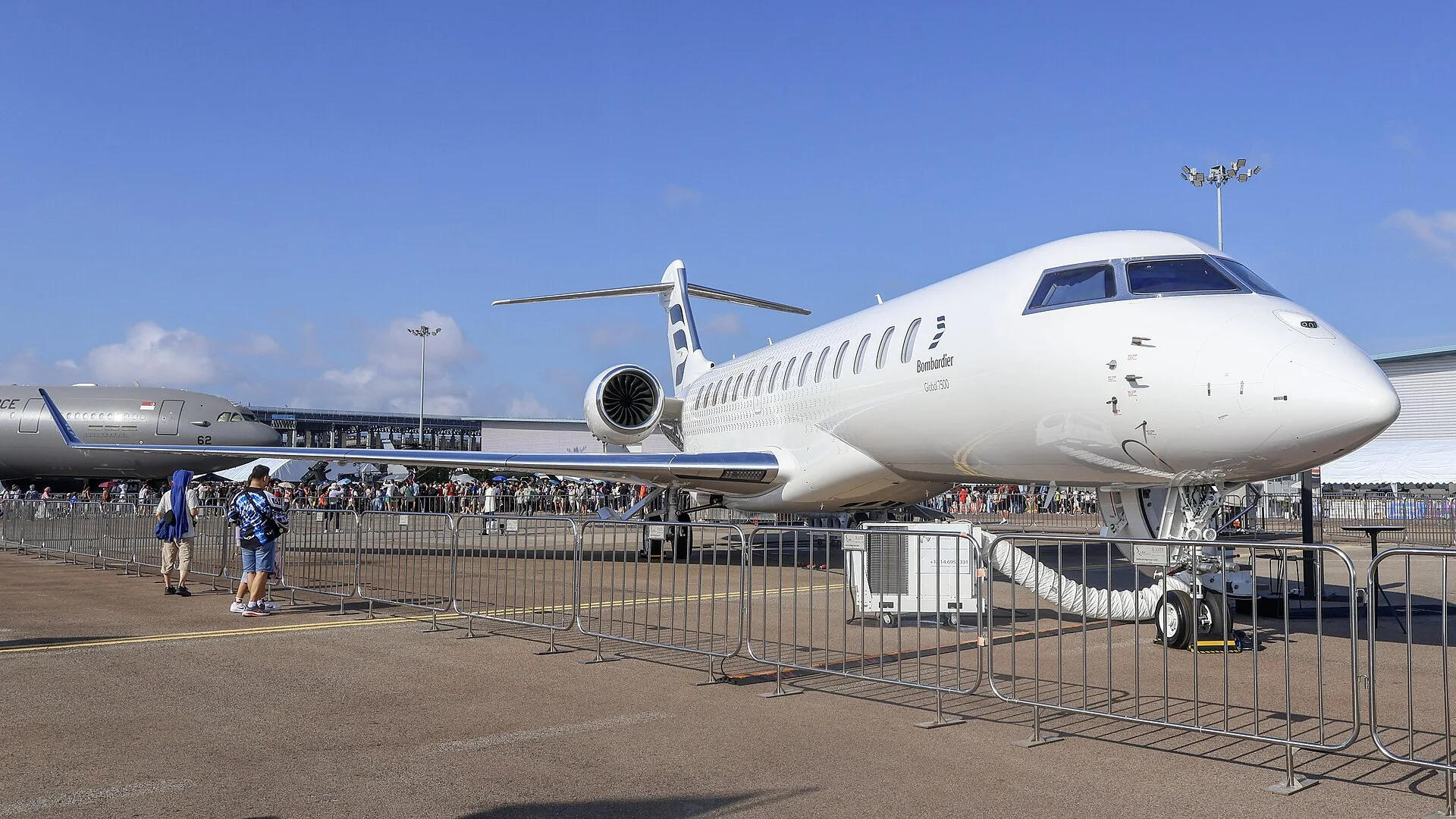
Every Bombardier price target you can look up this morning is out of date, and not by a little. President Donald Trump posted his demand that the Canadian planemaker build in the United States or stop selling there at 1:39 PM on Monday 7 September 2026 – a day when the Toronto Stock Exchange was closed for Labour Day. The most recent analyst revision on the file is dated 31 August. Every published forecast on Bombardier was therefore set in a world where nobody had threatened to close the market that supplies more than half the company’s revenue.
That gap between the last forecast and the first trading session is where this piece lives. When Toronto opened on Tuesday 8 September, BBD.B printed C$295.00 against Friday’s C$315.12 close – a fall of 6.4%, on a day low of C$292.34. The Street’s average 12-month target of C$320.25 was set when the shares were around C$315; it now sits 8.6% above a price that has already moved. Nothing has been revised yet. What follows is what is currently projected, who projected it, and precisely when – so you can judge how much of it survives contact with the news.
Key facts: Bombardier and the Trump post
- Share price: C$295.00 at 09:32 ET on 8 September 2026, down 6.4% from the C$315.12 close of 4 September (Yahoo Finance, BBD-B.TO); the 52-week range is C$150.81 to C$377.77
- Performance: up roughly 90% over twelve months even after this morning’s fall, and up 35% year to date to Friday’s close, but 21% below the record close of C$373.41 on 27 July 2026
- Average analyst target: C$320.25 across 10 analysts, with a high of C$406.00 and a low of C$191.00, and a consensus rating of Hold – 5 buy, 4 hold, 1 sell (MarketBeat)
- The date that matters: the newest of those targets is 31 August 2026. None of them incorporates the 7 September post
- Q2 2026 revenue: $2.15 billion, up 6%, on 32 aircraft deliveries, with adjusted EBITDA of $325 million at a 15.1% margin
- Backlog: $21.8 billion at 30 June 2026, up $4.3 billion since year-end 2025, on a unit book-to-bill of 1.5x
- Company guidance: full-year 2026 revenue above $10 billion, with free cash flow guidance raised at Q2 to more than $1 billion; available liquidity about $1.9 billion and leverage at 1.6x
- US exposure: Trump claims more than 50% of revenue; Bombardier counters with 2,800 US suppliers across 47 states and $2.5 billion of annual US supplier spending
What Trump actually posted
The wording matters for anyone trying to price it, because it is a demand rather than a measure. “NO MORE SELLING BOMBARDIER IN THE UNITED STATES! Their products aren’t good enough!” the post begins, before making the actual ask: “If they want our Market, they must build here, and stop treating America like a ‘piggybank.'” There is no executive order, no tariff schedule, no Federal Register notice and no effective date. It is a statement of intent from the President on his own platform, and the market’s job this morning was to put a probability on it becoming policy.
It also did not come from nowhere. The dispute opened in January 2026, when the administration said it was decertifying Bombardier’s Global Express aircraft and floated a 50% tariff on Canadian-built planes, tying the move to Transport Canada’s slow certification of the Gulfstream G500, G600, G700 and G800. Monday’s post repeats that grievance almost verbatim: “They even blocked Gulfstream Aerospace from doing business in Canada.”
What analysts project – and when they projected it
Here is the full picture of what the sell side currently has on the file. Read the date column first.
| Firm | Date | Previous target | New target |
|---|---|---|---|
| JPMorgan Chase | 31 August 2026 | C$295.00 | C$350.00 |
| TD | 3 August 2026 | C$306.00 | C$320.00 |
| Royal Bank of Canada | 31 July 2026 | C$383.00 | C$406.00 |
| BMO Capital Markets | 31 July 2026 | C$350.00 | C$375.00 |
| National Bank Financial | 31 July 2026 | C$349.00 | C$379.00 |
Two things fall out of that table that the headline consensus number hides.
First, the direction of travel was up, hard, right until the post. Four of the five most recent revisions raised the target, and JPMorgan’s was a 19% increase eight days ago. Those were responses to a Q2 print that beat: revenue of $2.15 billion, adjusted EBITDA of $325 million at a 15.1% margin, and free cash flow of $228 million against a $164 million outflow in the same quarter of 2025 – a $392 million swing.
Second, the C$320.25 average is dragged down by stale outliers, not by caution about Trump. The five firms above cluster between C$320 and C$406. The average includes a C$191 low target that is 35% below the current price and looks like a forecast nobody has refreshed. Read the panel rather than the mean and the pre-post Street was positioned nearer C$350 than C$320. Other aggregators using wider panels published averages closer to C$349-355 for the same reason. This is why “the consensus” is not one number and should never be quoted as though it were – the same problem we ran into pricing the Fed this week in our gold and Fed rate analysis, where three venues disagreed by fifteen points on the same event.
The consensus rating is Hold: five buys, four holds and one sell. On the numbers as they stood on Friday, that Hold implied roughly 1.6% of upside. On this morning’s C$295.00 it implies 8.6% – purely because the price fell, not because anyone became more optimistic.
What the company itself projects
Bombardier’s own guidance is the other half of “what is projected”, and it has been revised more recently than most of the analyst file. For 2026 the company guides to revenue above $10 billion, and at the second-quarter results on 30 July it raised free cash flow guidance to more than $1 billion, from a previous range of $600 million to $1 billion.
The balance sheet behind that is no longer the fragile one investors remember from the turnaround years: available liquidity of approximately $1.9 billion and an adjusted net debt to adjusted EBITDA ratio of 1.6x, approaching the company’s 1.5x target. Chief executive Éric Martel framed the quarter around execution rather than macro: “Our profitability growth, record services revenue and robust free cash flow are all rooted in the quality of our team and their collective commitment to our customers.”
The single most important number for judging the Trump risk is the backlog. It stood at $21.8 billion on 30 June 2026, up $4.3 billion since year-end, on a unit book-to-bill of 1.5x – meaning Bombardier booked half as many aircraft again as it delivered. Services revenue hit a record $674 million, up 14%, and services is a recurring, installed-base business that a sales ban does not touch for years.
Why the shares fell 6% and not 30%
A threat to close off more than half of a company’s end market sounds like it should be worth far more than 6.4%. Three structural facts explain why the market is discounting it rather than capitulating to it, and they are the same three that any revised target will have to weigh.
The near-term revenue is already sold. A $21.8 billion backlog against roughly $10 billion of annual revenue is more than two years of production spoken for. An import restriction would hit new orders first and deliveries second; it would take time to reach the income statement, and time is what gives a negotiation room to run.
The product is substantially American. Bombardier’s response to the post leaned on this hard, and the specifics are checkable: engines, avionics and other key systems from US suppliers, 2,800 US suppliers across 47 states, roughly $2.5 billion of annual US supplier spending, employees in more than 20 states – and, pointedly, “the wings for the world’s fastest business jet are made by American workers at Bombardier’s facility in Red Oak, Texas.” A ban on Bombardier sales in the US is also a tax on a Texas wing plant, which is a politically awkward shape for the policy to take.
There is no instrument yet. January’s threatened 50% tariff and decertification did not arrive as written either. Markets have learned to price the distance between a Truth Social post and a Federal Register notice, and this morning’s 6.4% is roughly what that discount looks like: real, but far short of pricing a ban as fact.
The counter-argument deserves equal weight. Business jets are discretionary, high-ticket purchases with long lead times, and uncertainty alone can freeze a US buyer’s decision without any policy ever being signed. That is the channel through which this becomes a numbers story rather than a headline: not a ban, but a quarter or two of soft US orders showing up in the book-to-bill. The demand backdrop for the sector, and the cross-border trade pressure driving it, is the same one we traced in our coverage of how supply shocks reprice through to yields.
What to watch next
1. Revisions, and how fast they come. The first analyst note that explicitly prices the post will reset the range. Watch whether the C$191 low gets refreshed – a stale outlier being updated would move the average more than any single new bull case.
2. Any actual instrument. An executive order, a tariff schedule, a decertification notice or a Section 232 action would change this from rhetoric to policy. Until one of those exists, the 8.6% gap between the price and the average target is a bet on nothing happening.
3. The Q3 book-to-bill on 30 October or thereabouts. The 1.5x from Q2 is the cleanest single number in the story. If US buyers pause, it shows up there first, before it ever reaches revenue or guidance.
4. Ottawa’s response. The post explicitly ties the grievance to Canadian treatment of Gulfstream and of US banks. A Transport Canada decision on the Gulfstream certifications would remove the stated justification, which is the fastest de-escalation path available.
Having covered this file since the January decertification threat, our read is that the market is pricing roughly what the evidence supports: a real risk, a low probability of the maximal version, and a company whose backlog buys it time to negotiate. What nobody can price yet is the revision cycle – and until the sell side updates, every target you read on Bombardier describes a world that ended at 1:39 PM on Monday. For the wider list of tickers moving on this administration’s trade actions, see our round-up of the industrial and energy complex and our Nvidia analysis on how policy risk gets discounted in practice.
Frequently asked questions
What is the Bombardier stock price prediction after Trump’s announcement?
The published average 12-month target is C$320.25 from 10 analysts, with a high of C$406.00 and a low of C$191.00 and a consensus rating of Hold. The critical caveat is timing: the newest of those targets is dated 31 August 2026, a week before Trump’s 7 September post, so none of them prices a US sales ban. Against the C$295.00 print on 8 September, the average implies 8.6% upside.
What did Trump say about Bombardier?
In a Truth Social post at 1:39 PM on 7 September 2026 he wrote “NO MORE SELLING BOMBARDIER IN THE UNITED STATES! Their products aren’t good enough!” and claimed over 50% of the company’s revenue comes from the US. His actual demand was conditional: “If they want our Market, they must build here.” No executive order, tariff schedule or effective date accompanied the post.
How much did Bombardier stock fall?
BBD.B opened the 8 September session at C$295.00 against the 4 September close of C$315.12, a decline of 6.4%, with a day low of C$292.34. The Toronto Stock Exchange was closed on 7 September for Labour Day, so this was the first opportunity for the market to price the post.
How much of Bombardier’s revenue comes from the United States?
Trump asserted more than 50%. Bombardier did not dispute the figure in its response, choosing instead to stress its American footprint: 2,800 US suppliers across 47 states, about $2.5 billion of annual spending with those suppliers, employees in more than 20 states, and wings for its fastest business jet built in Red Oak, Texas.
What is Bombardier’s guidance for 2026?
The company guides to full-year 2026 revenue above $10 billion and raised its free cash flow guidance at the Q2 results to more than $1 billion, from $600 million to $1 billion previously. It reported available liquidity of roughly $1.9 billion and an adjusted net debt to adjusted EBITDA ratio of 1.6x against a 1.5x target.
Does the backlog protect Bombardier from a US sales ban?
Partly, and for a while. The order book stood at $21.8 billion on 30 June 2026, more than two years of revenue at the current run rate, and grew $4.3 billion in the first half on a 1.5x unit book-to-bill. A restriction would suppress new US orders long before it reduced deliveries, which is the main reason the equity fell 6% rather than pricing the threat as an accomplished fact.
This article is analysis, not investment advice. Prices are as of 09:32 ET on 8 September 2026 and the market was open at the time of writing.