
Updated 25 August 2026
Robinhood Markets (NASDAQ: HOOD) traded at $104.00 in the pre-market on 25 August 2026, up 0.37%, after closing at $103.62 on 24 August, down 4.17% from a $108.13 previous close, per stockanalysis.com. Market capitalisation is about $93.16 billion and the one-year range runs $63.52 to $153.86.
Verdict: Robinhood has quietly stopped being a crypto broker. Event contracts and options now carry the growth while crypto revenue shrinks, and the market has not finished repricing that swap. Street range from 28 analysts: bull $163.60 (+57.9%), base $119.93 (+15.7%), bear $57.00 (-45.0%). The spread is the widest on any large US broker, and that is the whole argument.
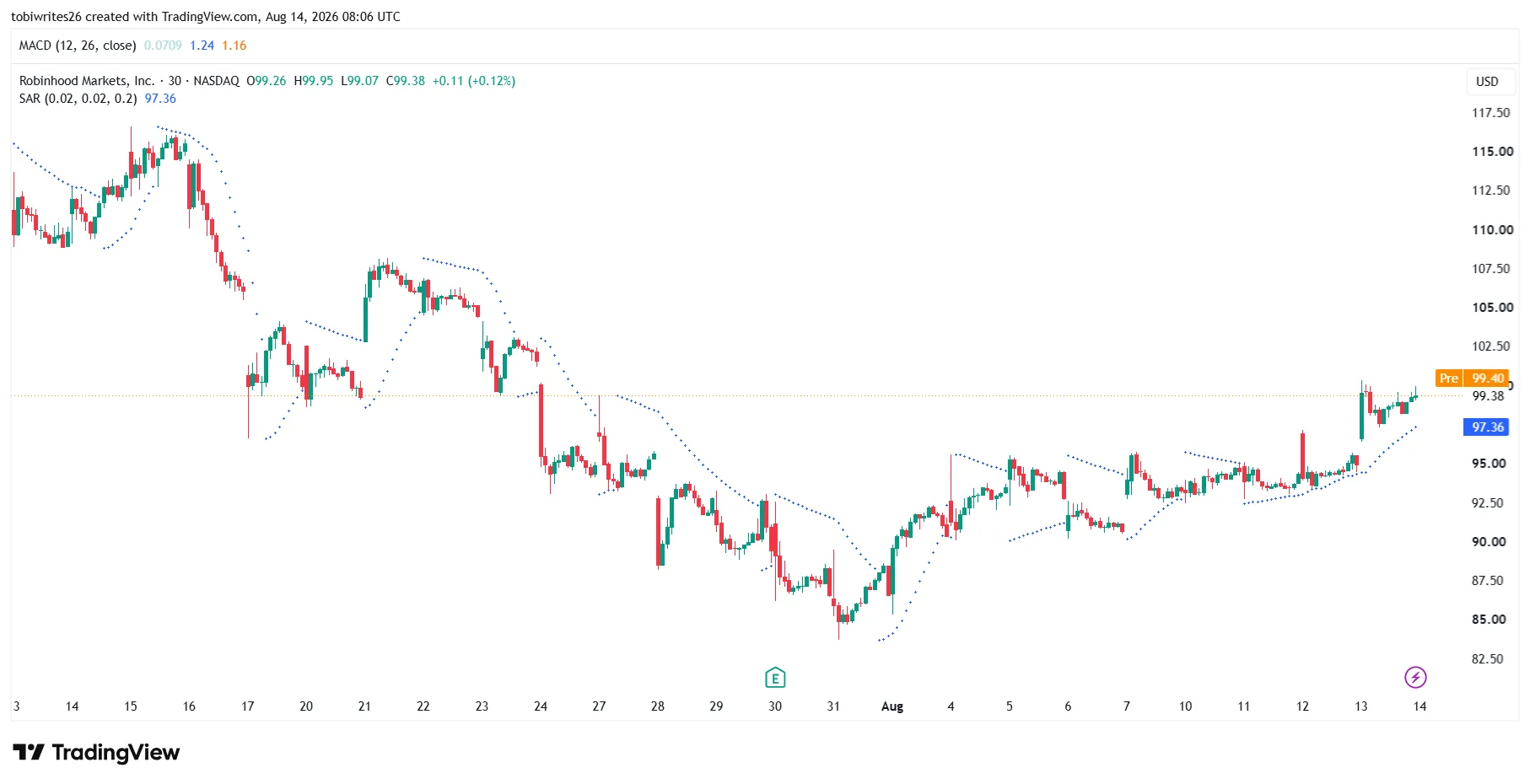
The single most repeated claim about Robinhood right now is that the stock is at its highs. It is not. HOOD closed at $103.62 on 24 August 2026 after falling 4.17%, and that leaves it roughly 32.7% below the $153.86 high it set within the past twelve months, per stockanalysis.com. It is closer to its annual low than most of the coverage implies: $63.52 is 39% down from here, $153.86 is 48% up.
What makes HOOD genuinely difficult to value is that the business underneath it changed shape faster than the ticker’s reputation did. Robinhood is still discussed as a leveraged bet on retail crypto enthusiasm. In the most recent quarter, crypto revenue fell 38% and the company still printed record revenue, because two other lines – options and event contracts – grew fast enough to cover the hole and then some. Every argument about where this stock goes next runs through whether that substitution is durable.
Key facts
- $104.00 – HOOD pre-market price, 25 August 2026, 9:11am ET, +0.37%; previous close $103.62 on 24 August, -4.17% – stockanalysis.com
- -32.7% – distance below the $153.86 twelve-month high; one-year range $63.52 to $153.86; market capitalisation $93.16bn – stockanalysis.com
- $1.31bn – Q2 2026 total net revenue, up 32% year on year and a company record; net income $573m, up 48%; diluted EPS $0.62, up 48% – Robinhood Q2 2026 results, 29 July 2026
- $156m – Q2 event contracts revenue, up more than tenfold year on year, on a record 13.6 billion contracts traded – Robinhood Q2 2026 results
- $100m – Q2 crypto revenue, down 38% year on year, against options revenue of $342m (+29%) and equities revenue of $129m (+95%) – Robinhood Q2 2026 results
- $10.9bn – July crypto notional trading volume, down 33% from June and down 62% year on year; the Robinhood app’s own share was $4.3bn, down 74% year on year – Robinhood July 2026 operating data, 12 August 2026
- $333bn – July equity notional volume, up 59% year on year, with 324m options contracts traded, up 66% year on year, against 28.5m funded customers – Robinhood July 2026 operating data
- $119.93 – average 12-month price target across 28 analysts, consensus Buy; median $123.50, high $163.60, low $57.00 – stockanalysis.com, retrieved 25 August 2026
The stock is not at its highs, and the last four sessions show why
The recent tape is unusually informative because it separates the two things moving this stock. On Friday 21 August HOOD rallied hard on a combination of a Goldman Sachs target increase to $123 from $118 and enthusiasm for the private-markets product push. Sources put that single-session move between 12.4% and 13.8% – TradingKey recorded 12.39%, StocksToTrade 13.8% – so treat the exact figure as approximate rather than precise. FinanceFeeds covered the scale of it at the time: the company added about $11.7 billion of market value in a day and outran bitcoin itself.
Then on Monday 24 August it gave back 4.17%, closing at $103.62. There was no company news. The Nasdaq fell 1.46% and the S&P 500 0.51%, and the crypto-adjacent complex fell harder than the index.
That is the pattern worth internalising. HOOD still trades with a high beta to risk sentiment and to bitcoin in particular, even though the crypto revenue line has shrunk to under 8% of the quarter. The business has diversified away from crypto. The share price has not. For a buyer, that gap is either the opportunity or the trap, and which one it is depends entirely on the next section.
What Q2 actually showed: event contracts became the growth engine
Robinhood reported second-quarter 2026 results on 29 July. Total net revenue was $1.31 billion, up 32% year on year and a record. Net income rose 48% to $573 million and diluted EPS rose 48% to $0.62. Transaction-based revenue – the volatile part – rose 44% to $776 million.
Inside that transaction line, the composition is the story:
- Event contracts: $156 million, up more than tenfold, on a record 13.6 billion contracts traded
- Options: $342 million, up 29%
- Equities: $129 million, up 95%
- Crypto: $100 million, down 38%
A year ago crypto was the swing factor in every Robinhood quarter. It is now the smallest of the four and shrinking, and the company still set a revenue record. Net interest revenue added $389 million, up 9%, and net deposits hit a record $21.7 billion in the quarter, a 28% annualised growth rate. Robinhood Gold reached 4.84 million subscribers, a 17% adoption rate among funded customers against 13.1% a year earlier, worth about $216 million annualised at $5 per month.
The subscription and interest lines matter more than they look, because they are the part of the model that does not need a volatile tape. Thirteen separate business lines cleared $100 million in the quarter. That is a different risk profile from the 2021 company that lived and died on payment for order flow in a meme-stock cycle.
The crypto line is collapsing, and the market keeps pricing it as though it still matters most
July’s operating data, published on 12 August, was ugly in exactly one place. Crypto notional trading volume was $10.9 billion, down 33% from June and down 62% year on year. The Robinhood app’s own crypto volume was $4.3 billion, down 74% year on year, with the Bitstamp acquisition supplying the remaining $6.6 billion. That is the weakest retail crypto activity the platform has seen in close to two years. FinanceFeeds covered the release in detail when Robinhood’s crypto volume fell 62% and the stock rose anyway.
The same report showed equity notional volume of $333 billion, down 15% from June but up 59% year on year, and 324 million options contracts traded, up 66% year on year, across 28.5 million funded customers. Retail did not go away in July. It rotated out of crypto and into options and equities – which, for Robinhood’s revenue mix, is close to a neutral-to-positive trade, because options monetise better per unit of customer attention than spot crypto does.
So the bear case cannot simply be “crypto volumes are down 62%.” That has already happened, and revenue hit a record in the same window. The bear case has to be about something else, and it is.
Scenario table: bull, base and bear
These anchors are the actual distribution of 12-month analyst targets across 28 covering analysts as of 25 August 2026, not modelled figures, measured against the $103.62 close on 24 August.
| Case | Target | Change vs $103.62 | What it requires |
|---|---|---|---|
| Bull | $163.60 | +57.9% | Event contracts compound from the $156m quarterly base without an adverse regulatory ruling, options growth holds near the 66% year-on-year pace, and the private-markets and tokenisation products convert into a second fee pool. Requires a new all-time high above $153.86. |
| Base | $119.93 | +15.7% | The current mix persists: crypto keeps shrinking, options and event contracts keep covering it, net deposits keep compounding near 28% annualised. Median target is a little higher at $123.50 (+19.2%). |
| Bear | $57.00 | -45.0% | The prediction-markets legal challenge goes against the industry and removes the fastest-growing revenue line, while a risk-off tape drains options and equities volume at the same time. Would take the stock 10% below its own twelve-month low of $63.52. |
Two things about that table deserve flagging rather than burying. First, the $57.00 bear is the single lowest of 28 estimates and sits below the twelve-month low – it is a genuine tail, not a mid-case. Second, the consensus is Buy and the median target of $123.50 implies 19.2% upside, so the central Street view is constructive; the width of the distribution, not its centre, is what is unusual here.
What has to go right for $163.60
The high target requires event contracts to become a structural business rather than a 2026 novelty. The base rate is encouraging: $156 million in a quarter, more than tenfold growth, 13.6 billion contracts. Bernstein’s estimate, carried in trade coverage rather than published directly, puts Robinhood’s full-year 2026 prediction-market revenue near $586 million, roughly 286% growth – treat that as a sell-side projection, not a company figure.
Two adjacent products carry the rest of the bull case. On 13 August Robinhood said it would accelerate launches of publicly traded closed-end funds holding stakes in private companies, including early-stage Y Combinator startups – a route for retail money into private markets that no competing US broker offers at that scale. And chief executive Vlad Tenev has been explicit that he sees tokenisation as the next platform shift, arguing that the tokenisation supercycle is just beginning.
Bank of America’s Craig Siegenthaler raised his target to $140 from $132 on 5 August with a Buy rating, and Goldman Sachs moved to $123 from $118 on 21 August. Neither is at the $163.60 top of the range, which is worth noting: the marginal analyst upgrade in August landed well short of the bull case.
What breaks the story: the regulatory line item
The bear case is concentrated, and it is not about crypto. Robinhood Predictions runs on Kalshi’s CFTC-regulated exchange infrastructure, and that entire regulatory perimeter is being litigated right now. Baltimore became the first US city to sue Kalshi and Polymarket over sports event contracts, the CFTC is litigating federal preemption against nine states, and Robinhood’s own event-contracts revenue is directly exposed to how that resolves – FinanceFeeds has tracked the legal fight over event contracts revenue as it developed.
The asymmetry is unpleasant. Event contracts are the fastest-growing line and the one most likely to be removed by a court rather than by competition. If sports event contracts were curtailed in enough US states, the tenfold growth line does not slow down – it inverts.
Competition is the second pressure. Kalshi, Polymarket – reported by CoinDesk in early August to be targeting a $20 billion valuation – Coinbase, FanDuel Predicts and Novig are all building in the same space, and Robinhood’s advantage is distribution rather than a proprietary exchange.
Valuation is the third. GuruFocus puts its GF Value estimate at $77.93, implying the stock trades about 33% above that fair-value calculation. That is one model among many, and it has been wrong on high-growth names before, but at $93 billion of market capitalisation HOOD is no longer priced as a broker – it is priced as a platform, and platform multiples compress fast when a growth line stalls.
Quick Take
Robinhood’s business diversified away from crypto faster than its share price did. Crypto revenue fell 38% in Q2 and crypto volumes fell 62% year on year in July, yet revenue hit a record $1.31 billion because event contracts grew more than tenfold and options grew 29%. At $103.62 the stock sits 32.7% below its twelve-month high, not at it. The bull case at $163.60 needs event contracts to keep compounding; the $57.00 bear needs a court to take that line away. Consensus Buy, median target $123.50.
Frequently asked questions
What is Robinhood stock worth right now?
HOOD closed at $103.62 on 24 August 2026, down 4.17%, and traded at $104.00 in the pre-market on 25 August, up 0.37%, per stockanalysis.com. Market capitalisation is about $93.16 billion.
What is the analyst price target for HOOD?
The average 12-month target across 28 analysts is $119.93, implying 15.7% upside from the 24 August close. The median is $123.50, the high is $163.60 and the low is $57.00. The consensus rating is Buy.
Is Robinhood still a crypto stock?
Less than it was. Crypto revenue was $100 million in Q2 2026, down 38% year on year and under 8% of total revenue, and July crypto notional volume fell 62% year on year to $10.9 billion. Options ($342 million) and event contracts ($156 million) are now the larger and faster-growing lines. The share price, however, still moves closely with bitcoin and general risk appetite.
How big are Robinhood’s prediction markets?
Event contracts generated $156 million of revenue in Q2 2026, up more than tenfold year on year, on a record 13.6 billion contracts traded. Robinhood Predictions operates on Kalshi’s CFTC-regulated exchange infrastructure.
Why did Robinhood stock fall on 24 August 2026?
There was no company-specific news. The decline of 4.17% came alongside a 1.46% fall in the Nasdaq and a 0.51% fall in the S&P 500, with crypto-linked equities falling harder, after a rally of roughly 12-14% on 21 August.
What is the biggest risk to the Robinhood bull case?
Regulation of event contracts. Baltimore has sued Kalshi and Polymarket over sports event contracts and the CFTC is litigating federal preemption against nine states. Because event contracts are Robinhood’s fastest-growing revenue line, an adverse outcome would remove growth rather than merely slow it.
Has Robinhood reached an all-time high in 2026?
No. The twelve-month range is $63.52 to $153.86 and the stock closed at $103.62 on 24 August, roughly 32.7% below that high.
Data sources: Robinhood Q2 2026 results (29 July 2026); Robinhood July 2026 operating data (12 August 2026); stockanalysis.com price and analyst-target data retrieved 25 August 2026; CoinDesk; GuruFocus. Price and target figures are point-in-time and change continuously.
This article is for information only and is not financial advice, an offer, or a recommendation to buy or sell any security. FinanceFeeds does not provide investment advice. Trading and investing carry risk, including the risk of losing more than your initial capital. Do your own research and consider consulting a licensed financial adviser before acting on any information here.